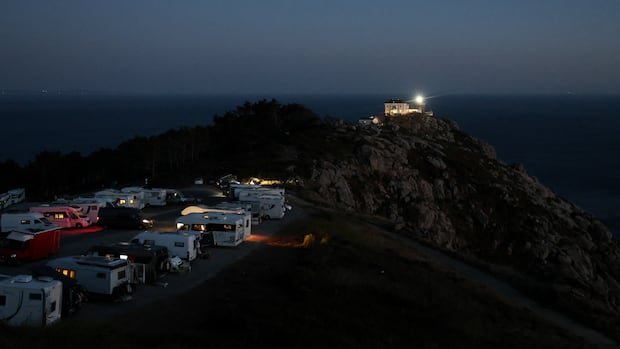
Hundreds of thousands of visitors have flocked to Spain to witness the solar eclipse happening this Wednesday. However, the occurrence coincides with high temperatures and an escalated wildfire risk in the country, causing concern for authorities aiming to prevent any fire damage resulting from the surge in astrotourism.
Virginia Barcones, the secretary general for civil protection and emergencies at Spain’s Interior Ministry, expressed the need to be cautious due to the severe summer in Spain, marked by a series of significant forest fires. The country has already seen approximately 400 fires scorching over 603,000 acres of land this year, as reported by the European Forest Fire Information System.
To mitigate the risk of additional fires during the eclipse, authorities are mobilizing 35,000 officers to monitor large outdoor gatherings on Wednesday. This proactive approach aims to detect and prevent any potential fires from starting, as highlighted by Barcones.
Spain stands as one of the prime spots for viewing the solar eclipse, with a narrow band of totality spanning regions in northern Russia, eastern Greenland, western Iceland, northeastern Portugal, and a substantial part of northern Spain, concluding at the Balearic Islands. The path of totality, around 200 kilometers wide, encompasses approximately 15 million residents, predominantly in Spain.
Only individuals within the totality path will witness the moon completely obscuring the sun. While Canada will experience a partial eclipse, cautionary reminders are being circulated to utilize eclipse glasses for eye protection. This solar eclipse marks the first time mainland Spain will witness a full eclipse in 120 years, driving a surge in travel enthusiasm.
In preparation for the eclipse, 660 official viewing sites have been designated by regional governments to accommodate an anticipated influx of over 440,000 individuals. Authorities estimate that around 1.5 million people could be traveling to these sites, emphasizing the importance of refraining from activities like barbecuing in dry areas with heightened fire risks.
The economic impact study by the Ministry of Economy, Trade, and Business projects that the solar eclipse could contribute over 347 million euros to Spain’s economy. However, with dry conditions and fire concerns prevailing, vigilance is crucial, especially with three major wildfires still raging in Huelva, Segovia, and Huesca provinces.
AEMET forecasts very high to extreme forest fire risks across the Iberian Peninsula and the Balearic Islands on the eclipse day. Additionally, Spain is facing exceedingly dry conditions, with July recording a mere 4.3 millimeters of rainfall, a quarter of the typical precipitation for the season. The susceptibility to wildfires is exacerbated by human activities, making it imperative to minimize potential ignition sources.
As eclipse enthusiasts remain undeterred by the heat wave and wildfires, the allure of witnessing this natural spectacle continues to captivate travelers. The eclipse’s unique phenomena, such as temperature drops and celestial visibility during the day, create a mesmerizing experience that often inspires repeat viewership.
Despite challenges, the shared experience of the eclipse serves as a reminder of the broader impacts of climate change, prompting reflection on the interconnectedness of global events. With more solar eclipses on the horizon for Spain in the coming years, including the 2027 event that could further boost astrotourism, the fascination with celestial phenomena is set to endure.