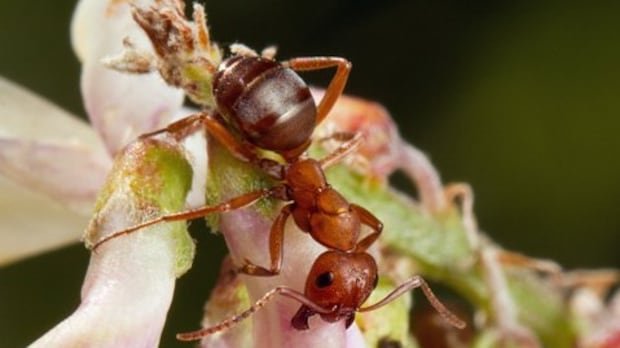
In the southeastern region of Alberta, the Cypress Hills stand as a remarkable sight emerging from the vast prairie landscape. Below the surface, a compelling scenario unfolds. Ants are firmly attached to plants and shrubs in Cypress Hills Provincial Park, involuntarily awaiting the chance to be consumed by unsuspecting herbivores. The perpetrator behind this peculiar behavior is the parasite known as Dicrocoelium dendriticum, a worm with an astonishing ability to manipulate its host like a zombie.
Researchers from the University of Calgary and University of Lethbridge highlight the uniqueness of this parasite in the realm of manipulative organisms. Unlike other instances of parasitic control, Dicrocoelium dendriticum can toggle its influence on and off, setting it apart in the world of parasitic manipulations.
Zombie parasites are widespread in nature, as explained by Cameron Goater, a parasitologist and professor at the University of Lethbridge. Various hosts across different species are affected by parasites that induce manipulative behaviors to facilitate their transmission. One well-known example is the Cordyceps fungus, featured in popular media, where infected ants climb plants to aid in the fungus’s reproduction cycle.
Unlike many other parasitic relationships resulting in the host’s demise, Dicrocoelium’s life cycle incentivizes keeping the host alive. The parasite’s complex life cycle involves multiple hosts, with grazing mammals like elk, deer, or cattle serving as the final host. Adult worms reside in the host’s liver, with their eggs excreted and subsequently ingested by snails.
Within snails, the eggs develop into larval forms called cercariae, which are then consumed by ants. The brainworm, a unique larval form, positions itself near the ant’s brain, prompting them to climb plants for potential consumption by grazing mammals.
This strategy poses risks for the infected ants, as they face exposure to predators, food deprivation, and heightened susceptibility to dehydration. To address these challenges, the parasite prompts the ants to detach from plants and return to the nest using an on-off mechanism based on external temperatures.
The intricate control exerted by Dicrocoelium inside the ant prompts questions about its ability to sense temperature variations and adjust its manipulation tactics accordingly. Researchers delve into the genetic and biochemical changes occurring during this manipulation process to unravel the mechanisms behind this phenomenon.
By deciphering the chemical signals and pathways involved in parasitic manipulation, scientists aim to gain insights into how these organisms exploit existing biological systems for their benefit. Understanding the intricate relationships between parasites and their hosts can shed light on emerging diseases and inform strategies for disease management and prevention.