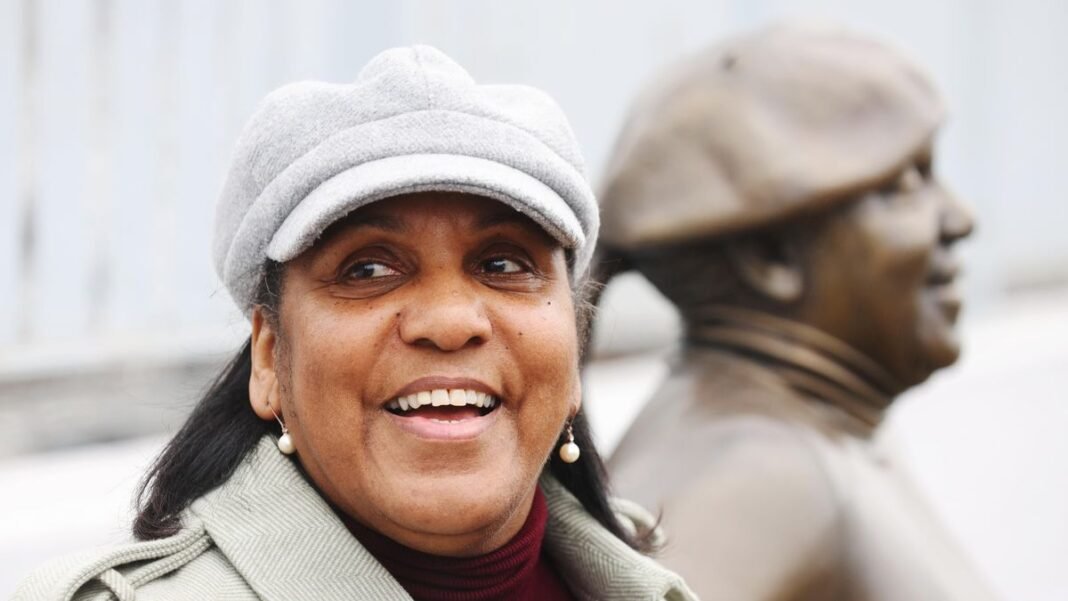
A survivor of breast cancer has been reconnected with her statue that was first revealed at Brixton station in London 35 years ago. Joy Battick, who was 26 at the time, is featured in what is believed to be among the earliest artworks depicting black individuals in England.
Artist Kevin Atherton, after locating Joy years later, crafted a second life-size bronze figure of her, now 62 years old, which was unveiled at Brixton station on Wednesday following the decision by Southeastern railway to restore the original three statues. The statue of the former South London resident now proudly stands opposite the original one on the platform.
With all four statues now in place, they symbolize the authentic representation of Brixton residents, according to Joy, who mentions that the experience has taught her to appreciate what she has. Joy expressed deep emotions, feeling overwhelmed by the achievement. She highlighted the changes in Brixton over the years, emphasizing the importance of acknowledging the community’s presence and history.
The figures, collectively known as Platforms Piece, were originally commissioned by British Rail as part of a £1 million improvement project. Over time, they had deteriorated and were at risk of falling. Installed in 1986, they were removed in 2016 for restoration.
Joy revealed that she had battled cancer in 2018, a couple of years before Kevin reached out to discuss reimagining her statue. She expressed gratitude for her recovery and emphasized the importance of cherishing health and life’s opportunities. Joy’s statue, named Joy II, was publicly displayed at the station alongside Mayor of Lambeth councilor Pauline George and Mr. Atherton, facing the original statue from across the platform.
The statues, representing Brixton residents, were part of an artwork called Platforms Piece – The Return, with the artist using local community models to capture the cultural essence of Brixton. Kevin described Joy as a significant symbol of Brixton’s identity over the years, noting that her recasting as a 63-year-old woman reflects a form of time travel.
Joy expressed her desire for acknowledgment from the Brixton community and believed that the statues held profound meaning for the area’s residents. Reflecting on her experiences and personal growth, she highlighted the changes in her outlook and emphasized the importance of progress and inclusivity.
The artist’s vision for the statues was to convey the passage of trains at the station while representing the diverse community of Brixton. The chosen figures, Peter Lloyd, Karin Heisterman, and Joy Battick, all had ties to the area.
Although no longer residing in Brixton, Joy, a mother of two, expressed her fondness for the area and her desire to return to her roots. Recalling the Brixton riots of 1981, a pivotal moment in history, Joy emphasized the impact of those events and the significance of her involvement in the statue project.
The statues, with Joy’s figure receiving listed status by Historic England in 2016, have become iconic representations of British black individuals in public art. Joy, originally volunteering to take part in the project for respite, expressed immense gratitude for the opportunity.
The original figures were hand-crafted using body casts, while Joy II was created using modern 3D scanning and printing techniques. Weighing approximately 200kg each, the hollow statues will be displayed at Brixton station, owned by Southeastern railway.