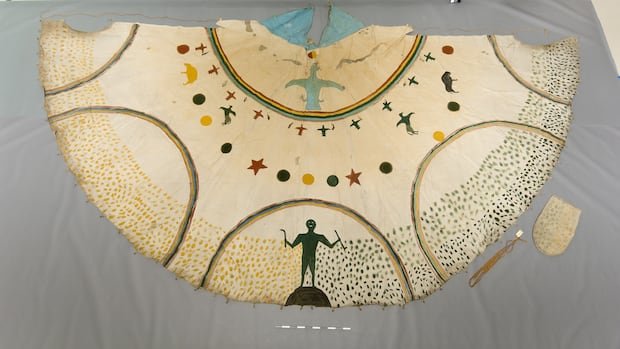
A professor from Saskatchewan unearthed a significant artifact from the province’s history while perusing the Smithsonian’s collection in Washington, D.C. The discovery, a teepee cover stolen from Kawacatoose First Nation nearly a century ago, is now set to return home.
Andrew Miller, an Indigenous studies professor at the First Nations University of Canada, stumbled upon the teepee cover while researching birds using the Smithsonian’s inventory. The cover, which went missing in the 1920s, was preserved through generations within the family’s storytelling tradition.
Upon spotting the teepee cover labeled “Dustyhorn—File Hills” with an acquisition date of 1926, Miller recollected a student’s mention of their belongings being housed in prominent U.S. museums. This recollection prompted him to reach out to Cory Dustyhorn, the current chief of Kawacatoose First Nation, to share his finding.
Cory Dustyhorn acknowledged the story of his great-great-grandfather Sîpiskwêsîkan’s stolen teepee and the unfulfilled promise of payment for it. Collaborating with Miller, Dustyhorn engaged with the museum, and to their relief, the Smithsonian displayed genuine understanding throughout the repatriation process.
In a significant gesture towards rectifying past injustices, the Smithsonian Museum acknowledged the unethical acquisition of some artifacts facilitated by the Indian Agent as an intermediary between Indigenous owners and buyers. In response, the museum introduced a shared stewardship and ethical returns policy in 2022, aligning with contemporary ethical standards in artifact collection.
After a century-long separation, the teepee is set to return to its rightful community, fostering a deeper connection between Dustyhorn, his family, and the entire Kawacatoose community. Plans are underway to establish a museum on Kawacatoose territory to showcase the teepee, with its temporary display at the Royal Saskatchewan Museum in Regina.
This momentous repatriation underscores the Smithsonian’s commitment to acknowledging past wrongs and upholding ethical standards in artifact stewardship, marking a significant step towards reconciliation and cultural preservation.