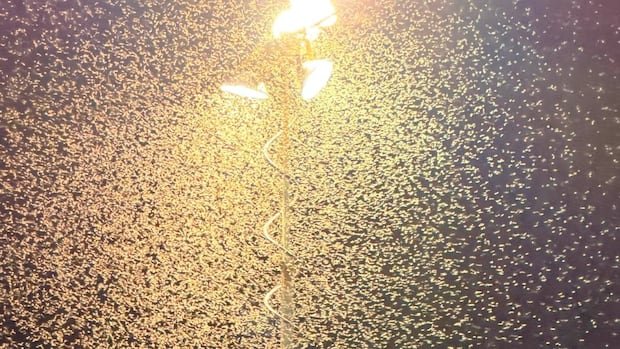
This year’s Pasadena Days-Humber Valley Strawberry Festival in Pasadena witnessed a remarkable yet perplexing concert experience with the unexpected arrival of spruce budworm moths in large numbers. Vanessa Newman, a member of the Corner Brook band Merrymaker, described the scene as resembling a blizzard. The moths swarmed overhead lights and covered a white tent, creating a surreal atmosphere.
Despite the inconvenience of moths landing on the performers and their instruments, Newman found the natural phenomenon fascinating. The audience remained engaged throughout the night, enduring the moth-infested surroundings. The band members had to maintain intense focus to avoid the insects entering their mouths or eyes.
The spruce budworm infestation in Pasadena is part of a larger outbreak affecting Newfoundland and Labrador. These insects, destructive in their caterpillar stage, pose a significant threat to the region’s forestry. The current outbreak, long anticipated but delayed, is expected to persist for several years, impacting tree health and forest management practices.
Lloyd Hollett, owner of the Newfoundland Insectarium, expressed astonishment at the scale of the infestation, extending beyond the Humber Valley. While the moth population has peaked in recent days, concerns linger about the implications for the following year. Natural factors, such as temperature fluctuations, play a crucial role in regulating spruce budworm numbers.
The provincial government’s decision not to conduct spraying operations this year reflects a shift towards targeted forest protection strategies. Despite past efforts to curb spruce budworm populations through extensive spraying, a more focused approach is now being adopted to safeguard high-value forested areas.
As Newfoundland grapples with the ongoing spruce budworm outbreak, officials are closely monitoring insect populations and tree health to determine future intervention measures. The province aims to sustain forest ecosystems and mitigate the impact of the infestation while awaiting favorable conditions for natural population control.