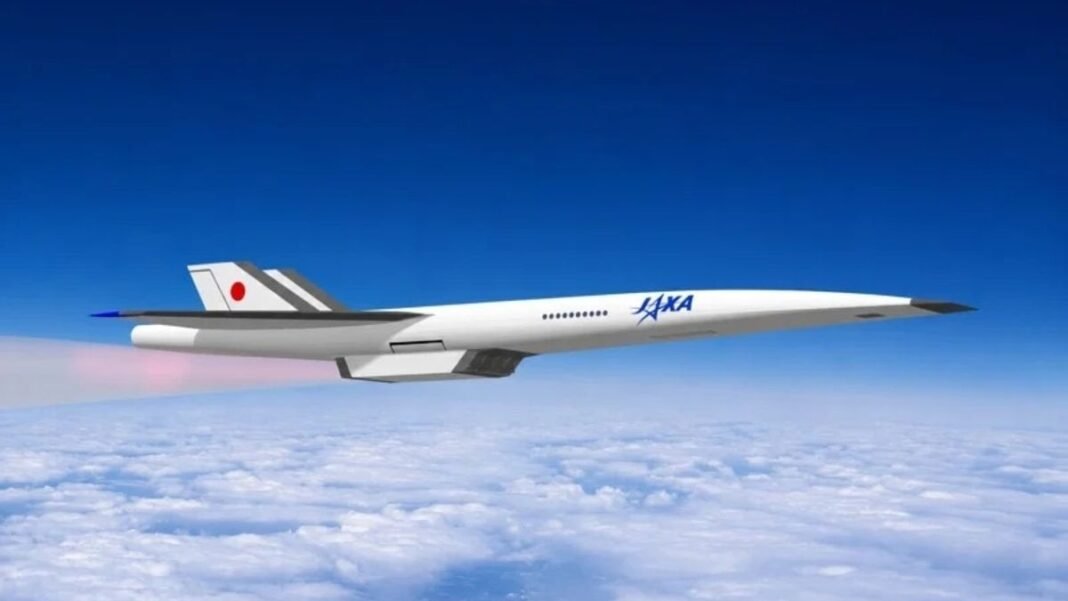
A Japanese organization is developing a hypersonic aircraft that could potentially reach speeds two and a half times faster than the Concorde. The Japan Aerospace Exploration Agency (JAXA) recently conducted a test where they placed an experimental aircraft inside a ramjet engine testing facility at JAXA’s Kakuda Space Center in Miyagi Prefecture. This test, conducted at Mach 5, which is five times the speed of sound, was a success and confirmed the aircraft’s thermal protection system, control surfaces, and ramjet combustion performance under extreme hypersonic conditions.
Such tests are essential for verifying the viability of the aircraft as temperatures around it can reach nearly 1,000 °C at that velocity. The next phase of the program may involve attaching the experimental aircraft to a sounding rocket or a similar launch vehicle for a practical Mach 5 flight demonstration. Japan’s efforts in hypersonic research are part of a global competition to develop ultra-high-speed transportation systems. If JAXA’s aircraft takes flight, it could significantly reduce the travel time from Tokyo to the US to just two hours, a vast improvement from the current half-day journey on regular commercial planes.
The hypersonic passenger plane is expected to fly at approximately 3,300 mph, six times faster than conventional aircraft. Comparatively, the supersonic Concorde passenger jet, which ceased operations in 2003, had a maximum speed of around Mach 2, with a recorded speed of 1,400mph. Despite the excitement surrounding the hypersonic aircraft, it will likely be many years before it becomes operational for commercial use.
Researchers estimate that the development of a hypersonic passenger aircraft typically takes about 20 years, with two stages of demonstration required: an experimental aircraft followed by a passenger aircraft. JAXA is not alone in the pursuit of commercial super or hypersonic aircraft, with other organizations like NASA and Boom Supersonic also making significant strides in this direction. NASA’s X-59 experimental aircraft and Boom Supersonic’s XB-1 have recently completed successful test flights aimed at addressing noise and efficiency challenges in supersonic travel.