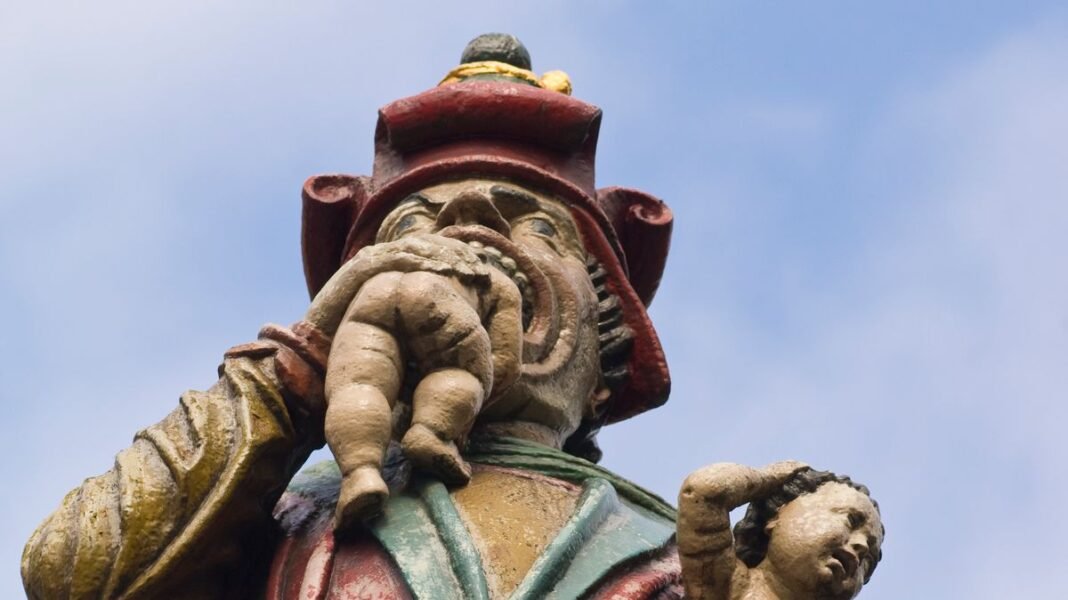
In Switzerland’s capital, a striking yet eerie statue has puzzled onlookers for nearly five centuries. The Kindlifresserbrunnen, known as the Fountain of the Eater of Little Children, stands in the heart of Old Bern. It portrays a monstrous figure in vibrant red, green, and yellow attire, devouring a baby’s head while other children appear in his grasp or within a bag nearby, all displaying expressions of impending dread.
Crafted by Hans Gieng in 1546, the statue is believed to be a replacement for an earlier wooden sculpture and is part of Bern’s extensive collection of public fountains. Despite its long history, the origins and purpose of this unsettling statue, often dubbed the Ogre Fountain, remain shrouded in mystery.
Various theories surround the statue’s symbolism, with some suggesting it as a cautionary message to the Jewish community due to the ogre’s hat resembling traditional Jewish headwear. Others link it to the mythological figure of Cronos, who feared being overthrown by his offspring and devoured them in Greek mythology. Additionally, speculations tie the statue to the tale of Duke Berchtold’s brother, who supposedly vented his jealousy by consuming the town’s children, though historical records do not support this claim.
Another interpretation posits the statue as a representation of Krampus, a folklore creature associated with Santa Claus in German-speaking regions. Krampus is known for scaring misbehaving children into good behavior during the Christmas season. Despite the diverse conjectures, the true significance of the Kindlifresserbrunnen remains elusive, captivating passersby with its enigmatic presence.