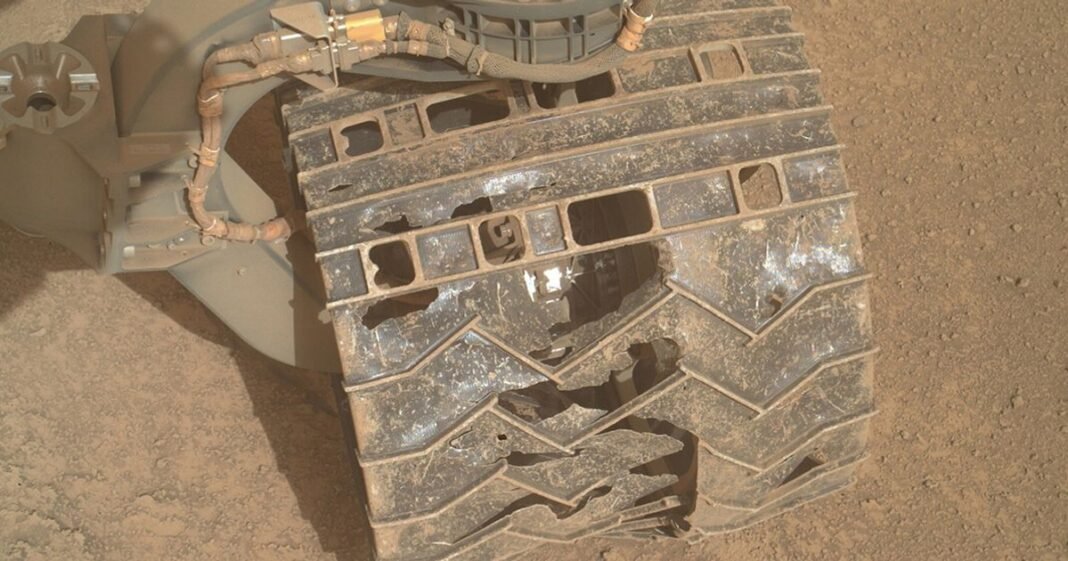
The Mars Rover’s self-portraits have revealed significant wear and tear on its tires after over a decade of exploration.
Launched from Earth in 2011, the Curiosity Rover, valued at $3.2 billion (£2.43 million), touched down on Mars in 2012 for what was supposed to be a two-year mission. Despite surpassing its expected lifespan, the rover remains operational, powered by nuclear energy, as it continues its investigations in the Gale Crater and Mount Sharp.
While Curiosity is sustained by nuclear power and could potentially function beyond 2026, recent images show signs of wear on its wheels.
The latest photographs, captured on Sol 4844 (March 23, 2026), depict the rover’s tracks deteriorating, with the rugged Martian terrain causing substantial damage.
Although the wear and tear do not amount to a flat tire 33.9 million miles away from home, the rover has previously encountered similar issues in July 2023, attributing its wheel damage to Mars’ rocky surface on social media.
Despite the visible damage, Curiosity’s operational capability remains unaffected, with its handlers confirming that the rover will continue fulfilling its duties. Experts have reassured the public about the rover’s resilience, with one planetary scientist emphasizing that even significant damage to the tires would not hinder its functionality.
Renowned scientist Emily Lakdawalla shared on Bluesky that Curiosity could operate normally even if two-thirds of its wheel rim were compromised. She further explained that the rover’s wheel motors possess sufficient torque to navigate challenging terrains, highlighting its robust design.
Curiosity, having spent over 14 years on Mars, continues to persevere despite visible tread damage. Experts remain confident in the rover’s ability to operate effectively, even with severely worn treads.
The rover’s self-captured images showcase the extent of the damage, emphasizing its resilience and adaptability to challenging Martian conditions. Scientists believe that Curiosity could maintain mobility even with only a fraction of its wheels intact, underscoring the rover’s engineering durability.