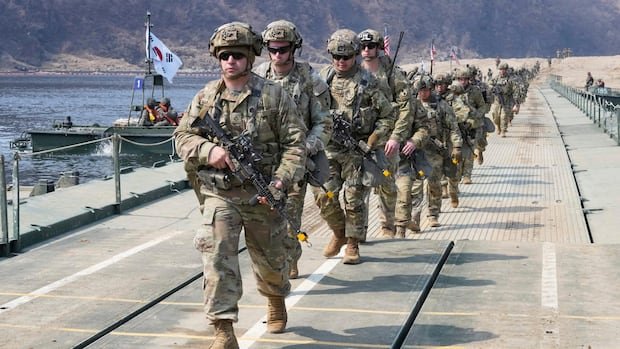
President Donald Trump has directed the Pentagon to reduce planned joint military exercises with South Korea, citing the need to denuclearize Iran and his positive relationship with North Korean leader Kim Jong-un. Trump expressed on social media that the exercises, scheduled to commence soon, are costly and send the wrong message to North Korea, which he described as non-threatening and respectful during his presidency.
Acknowledging that it is too late to cancel the exercises, Trump instructed Secretary of Defense Pete Hegseth to significantly scale back the joint military drills. He also mentioned that South Korea declined to assist in efforts to denuclearize Iran when requested. This move echoes Trump’s previous attempts to halt such exercises during his first term, labeling them as provocative.
Despite Trump’s directive, South Korea confirmed that the exercises began as planned. The South Korean government is reviewing Trump’s decision, expressing hope that the amicable relationship between the U.S. and North Korea could foster meaningful dialogue and promote peace and stability on the Korean Peninsula.
Regarding Trump’s assertion that South Korea refused to support denuclearization efforts in Iran, Seoul stated that it is exploring potential military contributions while assessing its defense readiness and following domestic legal processes. This decision reflects Trump appearing to favor leaders traditionally viewed as adversaries over allies, a trend observed in his administration’s interactions with NATO and other international partners.
The joint military exercises involving 18,000 South Korean troops were designed to enhance readiness against North Korean threats. These exercises reinforce the alliance’s role in regional peace and security, demonstrating the unwavering commitment between the U.S. and South Korea to safeguard their territories.
The U.S. and South Korea were expected to conduct various joint operations during the exercises, including precision targeting exercises, wet gap crossings, and the distribution of military equipment. These drills come shortly after North Korea resumed ballistic missile testing activities, violating UN regulations.
Criticism of Trump’s decision came swiftly from Democratic Sen. Mark Kelly, who deemed the reduction of joint exercises as short-sighted. The move follows recent ballistic missile testing by North Korea, the first since June, raising tensions in the region.
North Korea has intensified efforts to expand its nuclear and missile capabilities following the breakdown of diplomacy with the U.S. in 2019. The country warned of strong retaliation against the U.S. and South Korea, characterizing the military exercises as rehearsals for aggressive warfare, heightening regional instability.
Trump’s announcement to reduce joint military drills with South Korea emerged after he shared a photo standing alongside Kim Jong-un, emphasizing their positive rapport despite external appearances. The U.S. president has expressed willingness to engage in further discussions with North Korea following their previous meetings during his first term.