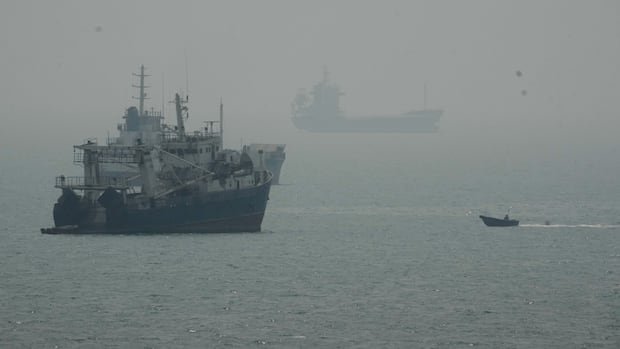
Iran announced on Wednesday that it had carried out attacks on 10 ships near the Strait of Hormuz in response to the sinking of five Iranian oil tankers by the U.S. This marks the most significant exchange of attacks on shipping by both sides since the onset of the six-month-long conflict.
The Islamic Revolutionary Guard Corps (IRGC) of Iran stated that they retaliated with a ballistic missile strike on a U.S. base near Al Azraq in eastern Jordan. Additionally, they targeted two U.S. vessels and eight oil tankers trying to navigate through a restricted area of the Strait of Hormuz that had been declared off-limits.
These incidents in and around the crucial waterway led to a surge in oil prices, with the international Brent crude benchmark surpassing $100 per barrel for the first time since July. Throughout the war, oil prices had fluctuated, dropping to as low as $70 amid hopes for a resolution between the U.S. and Iran to facilitate the safe passage of stranded tankers out of the Persian Gulf.
The escalating conflict between Saudi Arabia and the Iran-aligned Houthis in Yemen has added to market uncertainties. The Houthis recently launched attacks on four cities in Saudi Arabia, resulting in significant fires at oil installations visible from space and causing injuries to 73 individuals, as reported by Saudi authorities.
Consumers in the U.S. have experienced a notable increase in gasoline prices, with the average cost per gallon reaching $4.15 for regular gas and $5.90 for diesel. The situation has become a focal point ahead of the upcoming November midterm elections, with potential implications for the balance of power in the Senate and House of Representatives.
Amid these developments, Bank of America analysts expressed skepticism about reaching a lasting agreement before the midterm elections and even beyond. In Canada, gas prices have also risen by 25 to 40 percent since the conflict’s inception, prompting the government to extend a gas tax holiday until the end of January.
The U.S. military’s Central Command stated that they had destroyed five Iranian oil tankers in response to the IRGC’s targeting of a U.S. Navy warship with ballistic missiles. Secretary of State Marco Rubio emphasized that Iran’s attempts to strike U.S. naval ships would result in the loss of tankers.
Iran announced the establishment of a broader restricted maritime zone encompassing parts of the Gulf of Oman and the Arabian Sea, with specific coordinates to be disclosed. Meanwhile, an Iraqi fuel oil tanker was reportedly hit by a drone in Iraqi waters, causing a fire but no casualties among the crew.
The United Kingdom Maritime Trade Operations agency reported incidents of disabling fire on vessels in the northern Gulf and Gulf of Oman due to military activities in the region. Iran also issued threats against oil tankers in Kuwaiti and Bahraini ports, further complicating maritime transit in the region.
The conflict has severely disrupted the flow of oil and other resources through the Strait of Hormuz, impacting global energy markets. The U.S. has responded by implementing a military blockade of Iranian ports and assisting tankers’ passage through the strait, although the effectiveness of these measures remains uncertain.