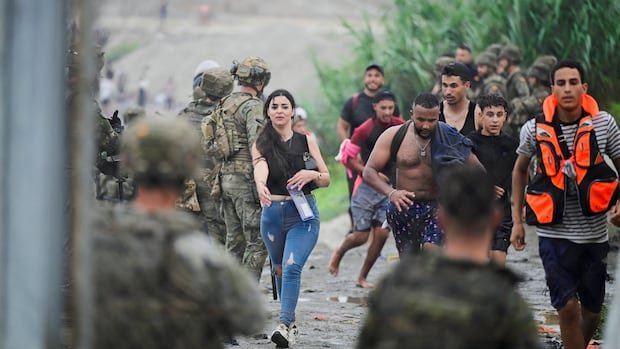
Spain and Morocco have fortified the border fence of a Spanish enclave to prevent mass crossings after tens of thousands of individuals arrived by sea and land within a day. According to officials, at least 57 people have lost their lives following the influx of around 60,000 individuals into Ceuta in recent days. As reported by Spain’s Interior Ministry, approximately 48,300 migrants returned to Morocco voluntarily by Friday evening.
The sudden surge of migrants into Ceuta, a small Spanish territory protruding into the Mediterranean from Morocco, has caused alarm and discord in Europe. France announced heightened border checks with Spain, while Italy threatened to suspend Spain from the European Union’s internal open border scheme. Moroccan authorities deployed water cannon trucks, batons, and tear gas at the Ceuta gates to push back individuals attempting to cross the border, resulting in clashes and the destruction of vehicles.
Despite a court ruling imposing restrictions on immediate expulsions from the enclave, Spanish authorities aim to swiftly deport those who entered illegally. Spanish Prime Minister Pedro Sanchez denounced the mass crossings as a violation of Spain’s territorial integrity and urged Morocco to increase efforts to stem the flow of people. Ceuta and Melilla, another Spanish autonomous city in northern Morocco, serve as the European Union’s sole land borders with Africa and frequently witness surges in migration attempts.
The recent increase in crossings may be linked to a ruling by Spain’s Supreme Court prohibiting the summary return of migrants intercepted at sea en route to Ceuta or Melilla. Migrants often swim from Moroccan towns like Fnideq to reach Ceuta, covering approximately five kilometers to Spanish territory. Despite reinforced security measures on the Moroccan side, some groups still sought alternative routes around the border fence, with preparations to swim across.
Migration remains a contentious issue in Europe, especially with the rise of right-wing parties post the 2015 refugee crisis. France announced a fivefold increase in police presence at the Spanish border, along with enhanced aerial surveillance and train patrols. In response to the situation, Germany and Italy expressed concerns over illegal immigration, with Italy considering extraordinary measures, including suspending the Schengen Area with Spain, to protect its borders.
While Spain upholds its stance against illegal crossings, it recognizes the economic contributions of immigrants and has offered mass amnesties leading to numerous applications for citizenship. The differing opinions on immigration policies have sparked tensions between European countries, with foreign ministers engaging in diplomatic exchanges over the handling of the migrant influx.