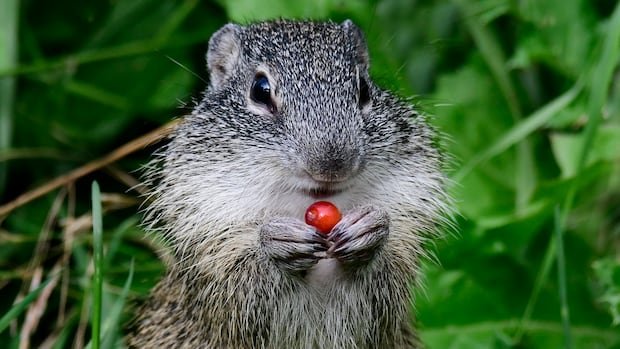
A call has been made by scientists to residents in Alberta to keep a lookout for a rare rodent species. The Franklin’s ground squirrel, a species currently under study in a research initiative led by wildlife biologist Jess Haines, is the focus of collaboration between Haines’ team at MacEwan University and Nature Alberta, a conservation group.
The research project was initiated due to declining sightings of the Franklin’s ground squirrel, as noticed by local naturalists who realized the lack of attention to the species. The primary goal of the project is to demonstrate the population decline of the Franklin’s ground squirrel, which is presently categorized as “undetermined” by the Alberta government due to insufficient data.
Jess Haines aims to gather substantial data on population trends of the Franklin’s ground squirrel through the ongoing project to potentially change its status to “at-risk.” Unlike Richardson’s ground squirrels, commonly known as gophers, which thrive in human-altered environments like pastures and golf courses, the Franklin’s ground squirrels depend strictly on natural habitats with dense vegetation and forested areas.
Human activities such as land conversion for agriculture and urban development have directly contributed to the reduction in Franklin’s ground squirrel populations. Previously widespread across central Alberta and into the southern boreal regions, the species is now limited to a few surviving populations.
Known locations where Franklin’s ground squirrels can still be found include Wabamun Lake Provincial Park, Pigeon Lake, Dry Island Buffalo Jump Provincial Park, Rochon Sands Provincial Park, and Buffalo Lake.
Contrary to other ground squirrel species that reside in large, visible colonies, Franklin’s ground squirrels naturally exist in small numbers and low densities, making them more vulnerable to disappearing from an area.
The research project, which includes fieldwork by Jess Haines and her team, invites public participation in spotting and reporting sightings of Franklin’s ground squirrels. Historical and current observations can be submitted via iNaturalist, a platform for sharing wildlife photos and recordings globally. Additionally, sightings can be reported through a form on the Nature Alberta website to help track the historical and current distribution of the species in the province.
The project, with no set end date but evolving priorities, currently focuses on understanding the squirrel’s diet and habitat across the province. The team plans to address specific questions concerning at-risk populations in the coming years.
Myrna Pearman from the Red Deer River Naturalists expresses her fondness for Franklin’s ground squirrels, highlighting their friendly behavior. She has joined Jess Haines in the field to photograph the squirrels, hoping to raise awareness for their protection by the provincial government.
With 14 squirrel species in Alberta, including five ground squirrel species, the Franklin’s ground squirrel stands out due to its distinct habitat requirements, grey head, and long bushy tail. As of now, no squirrel species in Alberta are classified as at-risk.