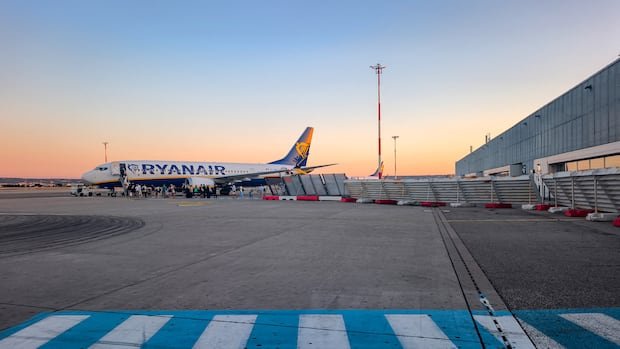
Broken engine parts caused a window to shatter on a Ryanair aircraft just after it took off in Greece last month, resulting in a passenger’s head being pulled out before other travelers managed to rescue him, according to U.S. investigators on Thursday.
A fan blade from the right engine of the Boeing 737-800 disintegrated, leading to fragments damaging the window and fuselage in multiple spots, as outlined in a preliminary report by the U.S. National Transportation Safety Board (NTSB).
The incident occurred on July 10 following the departure of the flight from Thessaloniki in northern Greece. Evidence of bird remains inside the engine suggested a possible bird strike during takeoff, although the exact cause of the fan blade detachment remains unknown.
The 61-year-old passenger involved suffered neck and shoulder injuries and friction burns as a result of being partially sucked out of the window. Flight attendants recalled hearing loud vibrations and observing smoke or fog filling the cabin, prompting the deployment of emergency oxygen masks.
Videos captured inside the aircraft showed passengers wearing oxygen masks after a loss of cabin pressure, with one clip revealing the blown-out window and emergency response efforts post-landing.
Maintenance records indicated that the failed engine’s fan blades underwent inspections in May 2026 and November 2025, with no prior damage detected. However, there were reports of four suspected bird strikes to the same engine within the past year, with bird remnants discovered after two incidents.
Ryanair CEO Michael O’Leary faced criticism from the NTSB for prematurely focusing the investigation on foreign object damage instead of considering other factors. The agency emphasized that all possibilities were being explored and that O’Leary lacked authorization to discuss the ongoing investigation.
The FAA had issued directives in 2025 mandating airlines to fortify certain engine components on Boeing 737s following prior fan blade failures. These changes aimed to prevent engine covering pieces from detaching and causing potential harm to the aircraft. Ryanair had not completed the required modifications by the July 2028 deadline set by the FAA.
Industry experts suggested that the recent incident might necessitate a reassessment of the modification timeline, considering the potential safety implications. Both the FAA and NTSB declined to provide further details on the active investigation, stating their commitment to ensuring safety based on the available evidence.
The Ryanair flight involved in the episode carried up to 189 passengers and was delivered to the airline in 2008. Flight data revealed a rapid ascent and subsequent descent for fuel burning before the aircraft safely returned to Thessaloniki. Malta Air, a subsidiary of Ryanair, operated the flight, with passengers disembarking without further incident.