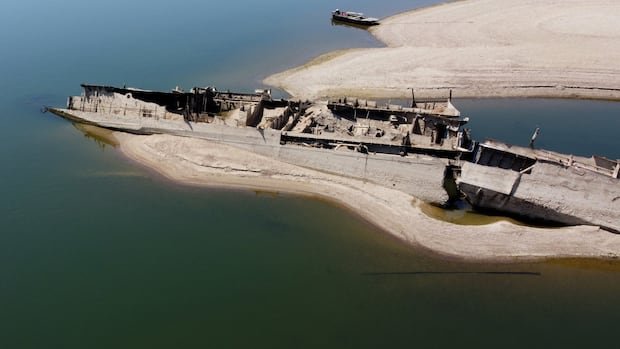
The Danube River is revealing Nazi German warships that were scuttled during World War II as water levels drop due to the ongoing heat and drought in Europe this summer. The Copernicus climate monitoring service confirmed that June and July were the hottest on record in western Europe, leading to an estimated 25,000 heat-related deaths.
The extreme heat has caused devastating wildfires and lowered water levels in important waterways like the Danube to record lows. Climate scientists warn that these events are clear indicators of the worsening impacts of fossil fuel-driven climate change on heatwaves, droughts, wildfires, agriculture, shipping, and energy systems in Europe.
Historians believe that up to 200 warships were deliberately sunk by the Nazis near the Serbian city of Prahovo in September 1944 to impede advancing Soviet forces. The drying Danube has also unveiled other artifacts such as a German military motorcycle in Hungary, an unexploded British bomb in Slovakia, and what appears to be ancient mammoth remains in Bulgaria.
Several countries along the Danube are facing urgent concerns as the river’s water levels reach historic lows. Measures like water use restrictions for irrigation and efforts to maintain nuclear power plants are being implemented to address the water scarcity. The extreme conditions are seen as a clear example of climate change intensifying heatwaves and droughts, leading to severe environmental consequences.
Experts warn that without significant reductions in greenhouse gas emissions, the current situation is just a glimpse of the future impacts of global warming. The unprecedented heat and drought in Europe this summer are expected to worsen next year, with the emergence of a super El Niño likely amplifying global temperatures further. The effects of climate change are already evident, and urgent action is needed to mitigate future environmental crises.