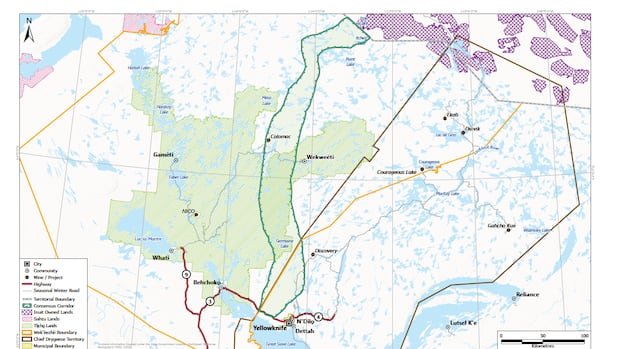
The Yellowknives Dene First Nation and the Tłı̨chǫ government have jointly agreed on the designated site for the Arctic Economic and Security Corridor. This 400-kilometre road project will link the Grays Bay Road and Port in Nunavut to the N.W.T. highway system, aiming to enhance military presence and mineral exploration in Northern Canada. Additionally, there are plans for spur roads connecting Wekweètì and Gamètì to the main corridor.
Led by the Yellowknives Dene First Nation and the Tłı̨chǫ government, with collaboration from territorial and federal authorities, the initiative marks a significant step towards Indigenous-led major projects, according to Tłı̨chǫ Grand Chief Jackson Lafferty.
The proposed corridor, approximately 30 kilometers wide, traverses the Slave Geological Province. Leaders stress that this is a preliminary proposal and not the final road layout. Both Chief Ernest Betsina and Chief Fred Sangris underscored the importance of minimizing impacts on the caribou population, as the area is vital for mineral exploration and serves as a caribou habitat and migration route.
The consensus on the corridor, following over a year of deliberation, integrates community-driven studies, traditional knowledge, and Western scientific insights. While the agreement represents a common ground, both nations acknowledge the corridor might not have been their individual first choice.
Premier R.J. Simpson expressed the Northwest Territories government’s support for the consensus and commitment to collaborating with the two Nations. This partnership exemplifies Indigenous-led development and government cooperation, crucial for the region’s future prospects.
Upon completion, the corridor will establish Canada’s initial land-based connection to Nunavut’s Arctic coast. The Tłı̨chǫ government and Yellowknives Dene First Nation will engage their members, neighboring Indigenous groups, and local residents to gather feedback on the proposed route to shape the project’s future direction.