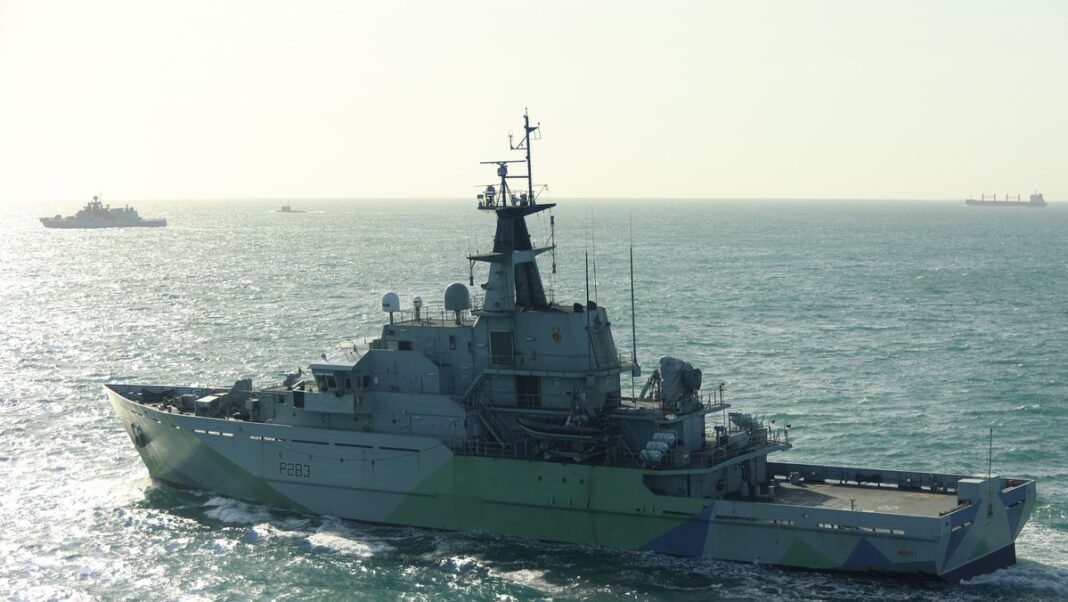
One of Russia’s prominent naval vessels has been closely followed by a series of Royal Navy ships for several weeks amidst escalating tensions between the UK and Russia.
Throughout the entirety of April, the frigate Admiral Grigorovich was monitored by patrol ships HMS Tyne, HMS Mersey, and HMS Severn as it navigated off the UK coastline. This surveillance operation, which extended to the North Sea and the area near the Galloper wind farm off the Suffolk coast, is noted as one of the most rigorous shadowing exercises conducted by the Royal Navy in the last ten years due to heightened Russian threats to the UK.
A spokesperson from the Royal Navy reported that HMS Tyne, HMS Mersey, HMS Severn, RFA Tideforce tanker, and Wildcat helicopters from 815 Naval Air Squadron maintained continuous tracking of the Russian Navy’s Admiral Grigorovich during the entire month of April. The Russian warship, along with its supporting vessels and escorted ships, was under constant observation by Royal Navy air and sea assets, as it moved between the North Sea and Western Approaches, accompanying Russian-flagged vessels traveling to and from the Atlantic, Mediterranean, and Baltic regions.
Furthermore, the frigate made stops for refueling and supplies near critical national infrastructure, such as the Galloper wind farm. This monitoring operation coincided with Russia’s increased utilization of its air force and naval units to test NATO response capabilities and probe close to European territories.
In a separate incident last month, UK and Norwegian forces intercepted a covert mission involving three Russian submarines, including Akula-class and GUGI vessels, gathering intelligence near vital underwater infrastructure and energy cables north of the UK. Although the monitoring prevented any damage, the mission was suspected of conducting reconnaissance or potential sabotage activities.
UK Defence Secretary John Healey issued a stern warning to Russian President Vladimir Putin regarding the activity near UK cables and pipelines, emphasizing that any attempt to disrupt them would have severe consequences. Notably, Russian reconnaissance planes have frequently approached UK airspace, prompting UK Typhoons to intercept and deter them.
Regarding the recent operation, Fleet Commander Vice Admiral Steve Moorhouse commended the crews for their professionalism, resilience, and operational readiness. He highlighted the Royal Navy’s swift deployment and coordinated monitoring efforts to ensure continuous surveillance of Russian warships, underscoring the Navy’s capability to maintain maritime security through effective leadership, teamwork, and operational excellence.