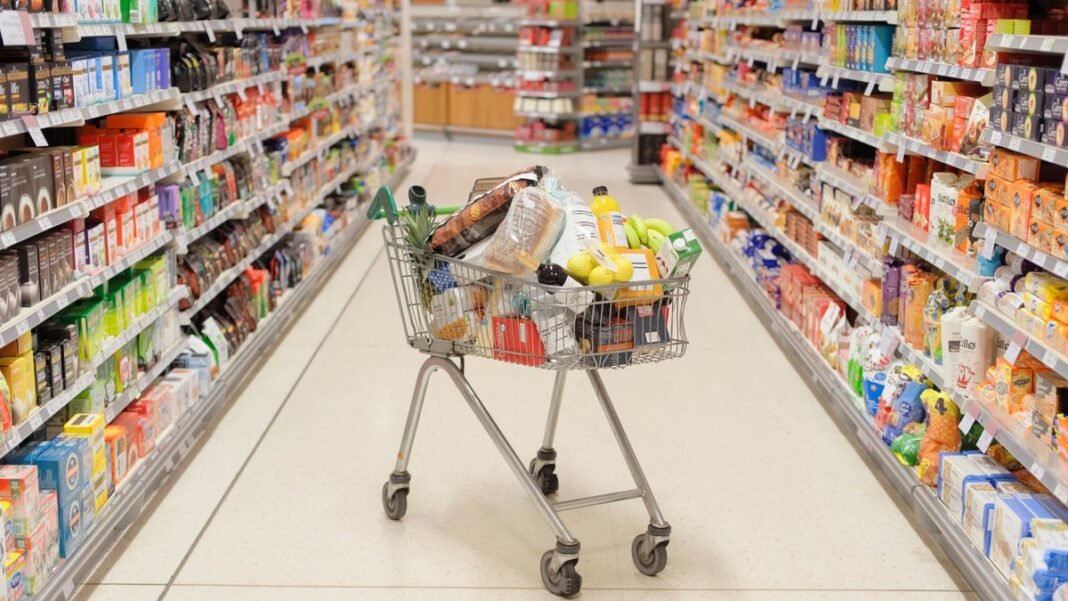
Shoppers are cautioned that despite a decrease in inflation, food prices could continue to rise in the upcoming months. Food inflation dropped to 2.2% in May, the lowest rate since December 2024, down from the previous 3% in April.
Karen Betts, the chief executive of the Food and Drink Federation, highlighted that the impacts of the Middle East conflict are still affecting costs. The closure of the Strait of Hormuz has led to higher energy and fertilizer expenses, resulting in increased production and distribution costs.
Betts mentioned, “While May saw a decline in food inflation, consumer prices have not fully reflected the inflationary effects of the Strait of Hormuz closure.” She explained that it typically takes some time for increased costs in farming, processing, and manufacturing to impact retail prices due to long-term contracts for energy and ingredients. However, with rising input costs for manufacturers, including transport and energy, it is expected that food inflation will rise throughout this year and into the next.
According to ONS data, prices showed the most significant increases for beef and veal (9.4%), offal (9.2%), preserved fruit (9.0%), and confectionary products (8.8%). On the other hand, prices decreased for various categories, with the most notable drops seen in flours (-6.1%), olive oil (-4.2%), and jams and marmalades (-3.0%).
Industry leaders had forewarned that while food price hikes may not reach the worst-case scenario, they are expected to persist into 2028. The Institute of Grocery Distribution (IGD) predicts an average food inflation rate of 3.2% to 4.2% next year and 2.3% to 3.3% in the first half of 2028.
Households with children may need to budget approximately £203 more for food and beverages this year, along with an additional £207 for the following year. In May, the Consumer Prices Index (CPI) remained steady at 2.8%, lower than economists’ expectations of a 3% increase.
Grant Fitzner, the chief economist at ONS, noted that inflation held firm in May due to various price movements offsetting each other. While transport costs, airfares, vehicle taxes, and petrol prices contributed to the upward movement, lower food prices, particularly in meat, dairy, and vegetable items, along with declining domestic heating oil costs, helped balance the overall inflation rate.