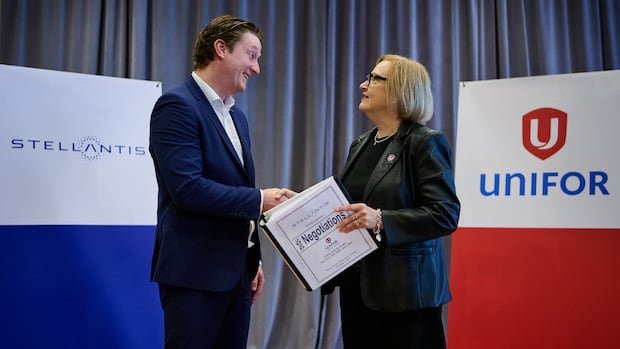
The labor union representing Stellantis workers in Canada has cautioned the automaker against undervaluing its Canadian workforce as contract negotiations between Unifor and the company commenced. Unifor is employing its customary pattern bargaining strategy in these talks, aiming to establish terms that can be replicated with other companies in the auto sector.
Despite recently reaching agreements with Ford Motor Co. and General Motors in Canada, Unifor’s national president Lana Payne emphasized that the upcoming negotiations pose significant challenges. The union is particularly concerned about job security following the layoff of over 2,000 employees at Stellantis’ Brampton, Ont., assembly plant, which has been inactive since 2023.
Last month, the union was notified that Stellantis was contemplating shutting down and selling the plant. Initially designated for Jeep production, the plant’s retooling began in early 2024 but was halted by the company in early 2025. The decision to relocate Jeep Compass production to the U.S. was viewed by the union as a breach of the existing collective agreement, resulting in the plant’s indefinite closure.
In response, Unifor reiterated its stance that the production of Jeep Compass should have remained at the Brampton plant, labeling the relocation as a misguided move. Payne stressed the necessity for Stellantis to restore trust with its workers and Canadians by reinstating production at the Brampton facility.
Stellantis acknowledged the significance of the labor discussions with Unifor for its future prospects. Trevor Longley, chairman, president, and CEO of Stellantis Canada, highlighted the company’s substantial investments in its Canadian operations since 2022, focusing on enhancing manufacturing capabilities and advancing battery technology in Ontario.
The ongoing negotiations are further complicated by the imposition of U.S. tariffs on non-domestic vehicles, with President Donald Trump threatening to escalate tariffs on Canadian automotive imports. Payne described the current economic climate as a critical moment for the Canadian auto industry, emphasizing the need to preserve the industry’s presence in the face of escalating trade tensions.
Larry Savage, a labor studies expert at Brock University, noted that Unifor is engaged in a dual battle, both at the bargaining table with Stellantis and in lobbying the Canadian government to safeguard the auto sector’s interests in international trade agreements.
The recent approval of new contracts by General Motors employees, with significant wage increases, underscores the union’s success in securing favorable terms for its members. Unifor’s alignment with the pattern bargaining strategy across automakers signifies its commitment to achieving equitable agreements within the industry.