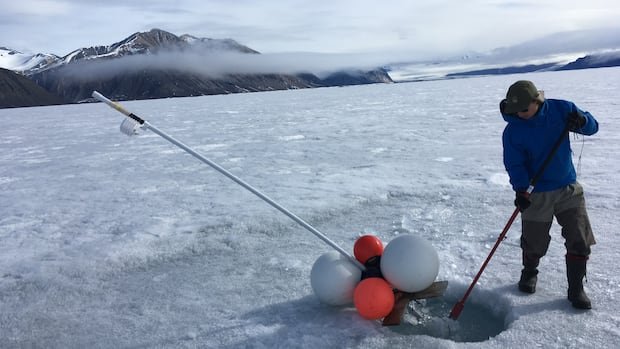
In a recent study, scientists have confirmed the disappearance of Canada’s last remaining epishelf lake, which consisted of freshwater floating on saltwater and supported a unique ecosystem. The lead author, Jérémie Bonneau, expressed sadness over the loss of the Milne Fiord epishelf lake on Ellesmere Island in Nunavut, emphasizing its significance as the only one of its kind in Canada.
The study, published in Scientific Reports, outlines how the warming climate in the Arctic led to the lake’s demise, marking the end of a 4000-year era. The Milne Ice Shelf, which dammed the mouth of Milne Fiord, allowed freshwater to accumulate on top of the Arctic Ocean’s saltwater, forming a floating layer due to the density difference between freshwater and saltwater.
The lake had been accumulating freshwater for over 4000 years, with a layer 18 meters deep in 1983. The ecosystem within the lake was unique, with distinct communities of bacteria, viruses, and phytoplankton in the freshwater and saltwater layers. The lake also supported diverse microorganisms, including species not previously reported in the Arctic.
The collapse of the Milne Ice Shelf in 2020 led to the lake’s disappearance as the freshwater drained into the saltwater fiord. The researchers observed the rapid loss of freshwater within two months of the ice shelf breakup, resulting in a significant change in the marine environment.
While epishelf lakes have disappeared from Canada, some still exist in Greenland and Antarctica. However, researchers believe these ecosystems are also at risk due to ongoing climate change. The loss of the Milne Fiord epishelf lake highlights the irreversible impact of environmental transformations on unique habitats worldwide.