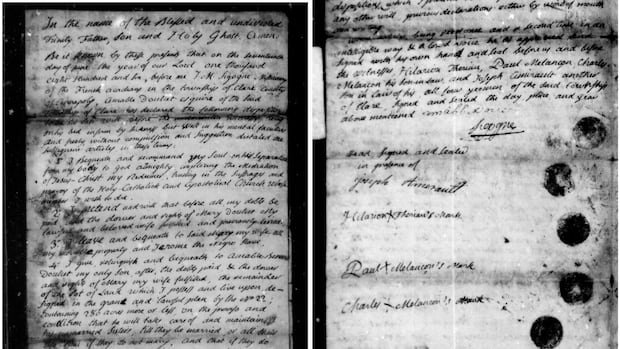
At the age of 71, Hilarion Thériault, feeling his time was near, made a rare decision among Acadians in the 19th century by creating a will. This was uncommon due to many Acadians lacking substantial property to pass down, a consequence of land loss after the Acadian expulsion. Moreover, Roman Catholics were prohibited from property ownership until the 1780s in the province. Despite these challenges, Thériault ensured he was prepared for his passing.
A study by Colby Gaudet, a post-doctoral fellow at Dalhousie University, delved into Thériault’s will and 23 others from the small Acadian community in Clare, N.S. The research aimed to shed light on how families navigated legal and religious practices during times of grief and death. Gaudet emphasized the dual nature of the act, serving as both resistance and adherence to existing legal models, while asserting their Roman Catholic identity.
Thériault’s will outlined his wishes for debt repayment, reparations for any wrongdoings in his memory, and providing peace for his family. These wills, as Maurice Basque, a historian at l’Institut d’études acadiennes at the Université de Moncton, noted, were crafted in a climate of severe social exclusion faced by Acadians.
Following the 1755 Acadian deportation, under Lt.-Gov. Charles Lawrence, Acadian lands were seized by the Crown, aiming to replace the Acadian population with settlers from New England. Despite some Acadians returning years later, they encountered systemic barriers, such as oath tests, designed to undermine their Catholic beliefs and access to positions of power.
Gaudet highlighted the language barrier faced by Acadians in Clare, as all county judges overseeing wills were Anglo-Protestant. The wills, written by priest Jean-Mandé Sigogne, acted as a crucial link between the Francophone Acadian families and the judiciary system.
The wills studied by Gaudet, left mainly by community leaders like Thériault, reflected the deep integration of the church and Catholicism into their lives, despite societal stigmatization at the time. Protestants typically invoked God in their wills, whereas Catholics, like Thériault and others, included specific religious details, such as references to the Virgin Mary and saints.
Gaudet’s research also unveiled insights into the relationships between Black individuals and Acadians. Notably, Amable Doucet’s will, which bequeathed a Black slave named Jerome to his wife, and Étienne Thibodeau’s will, appointing a Black man, Anselm Hatfield, as a witness, shed light on these connections. Hatfield, a free man from New York, had been an indentured servant to another community member, Paul Dugas.
In conclusion, the study of these wills provides a glimpse into the legal and religious complexities faced by the Acadian community in Clare, showcasing their resilience in navigating challenging times.