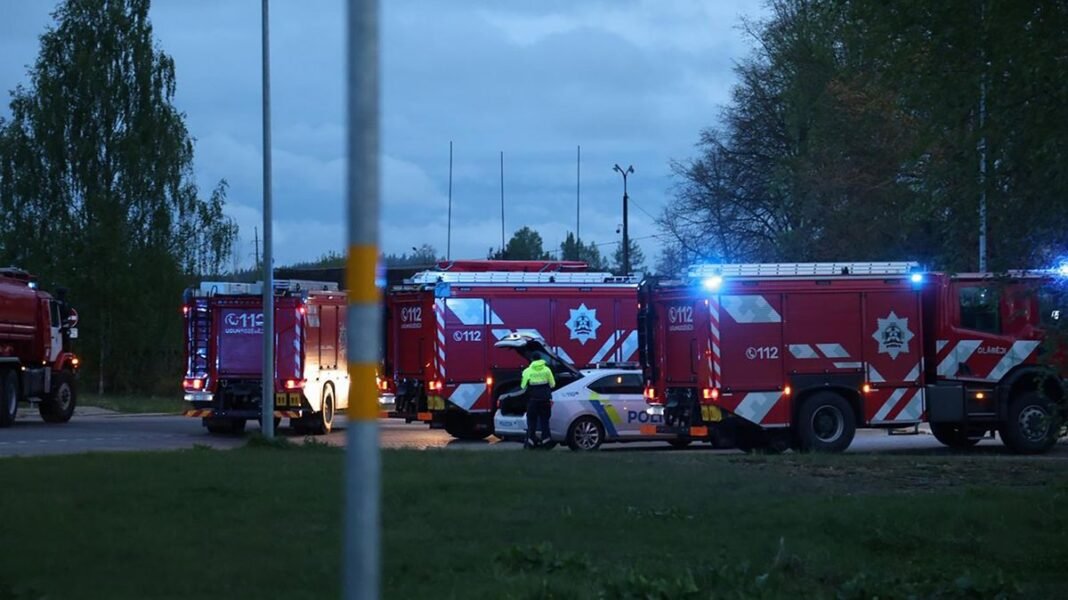
NATO fighter jets were dispatched above European skies in response to unidentified drones breaching Latvian airspace and targeting an oil storage facility. The rogue unmanned aerial vehicles ventured approximately 40 miles into the country, leading to one drone crashing at an oil depot in Rēzekne, a city located in the eastern part of Latvia, causing damage to four empty oil tanks.
Authorities swiftly initiated an investigation to determine whether these drone activities constituted a hostile maneuver by Russia or if Ukrainian UAVs, possibly disrupted by electronic warfare interference while engaging in operations within Vladimir Putin’s domain, had veered off course.
Residents in the Latgale region, which shares a border with Russia, were alerted to the airspace threat through mobile notifications at 4:09 am and 4:43 am, instructing them to stay indoors, shut doors and windows, and prompting the closure of schools in the Rēzekne and Ludza districts.
Defence Minister Andris Sprūds confirmed his journey to Rēzekne to manage the crisis, emphasizing that the situation remained complex and menacing. He highlighted the mobilization of NATO fighters as part of the Baltic Air Policing mission, stressing the necessity to enhance the functions of Baltic Air Policing due to Russia’s ongoing aggression in Ukraine and its wider regional repercussions.
This incident occurs against the backdrop of apprehensions that Russia is testing NATO’s determination through orchestrated provocations in the Baltic nations of Latvia, Lithuania, and Estonia. Russia’s claims accusing the Baltic countries of permitting Ukrainian drone incursions to target oil facilities near St. Petersburg have been refuted by these nations along with Finland.
Recently, a Russian-language war channel, Volya, comprising experts from Russia, Ukraine, Belarus, and the Baltics, warned of Russia’s purported plans to invade the Baltic states, posing a significant military challenge to Western powers. Such an incursion by Vladimir Putin would serve as a litmus test for NATO’s commitment to safeguarding the three smaller member states.
Volya reported receiving information from sources within the Russian Ministry of Defence, indicating an advancement in Vladimir Putin’s intentions to invade the Baltic states. The objective, as stated, is not to instigate a conflict with NATO but to induce a severe crisis within the alliance by seizing Latvia, Estonia, and Lithuania, potentially leading to its fragmentation.
The Russian political leadership’s strategy is predicated on the assumption that European nations would hesitate to confront a nuclear power without direct U.S. support, believing that major European countries would avoid engaging in a war with Russia over the Baltic states.
For quick access to news of interest, designate Daily Mirror as your ‘Preferred Source’ on Google News.